

Parsons Cemetery: A brief history
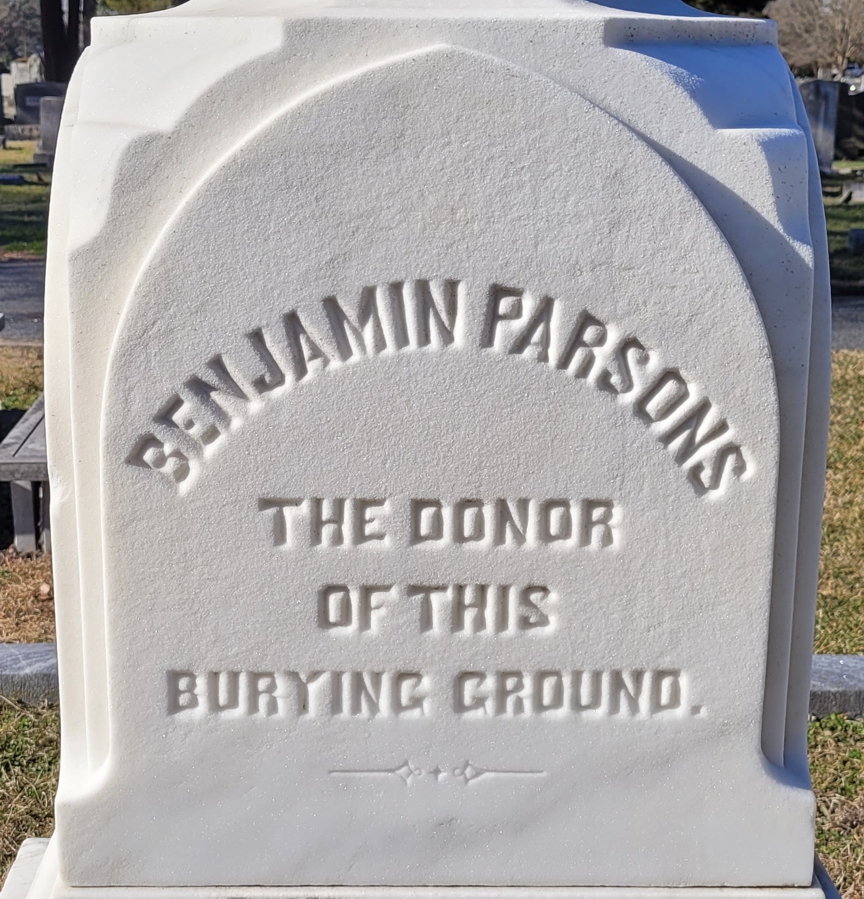
The history of Parsons Cemetery begins with the Parsons family burial ground prior to the Civil War. When Benjamin Parsons died in 1873 without any children, his will stipulated that his home and 53-acre farm were to go to St. Peter’s Episcopal Church as a cemetery. St. Peter’s moved the graves of their Church members from a small plot next to the Church to the newly acquired cemetery. The original cemetery was 2 acres in size, but over the years the cemetery has grown to 18 acres, covering an area from North Division St. to Johnson’s Pond.
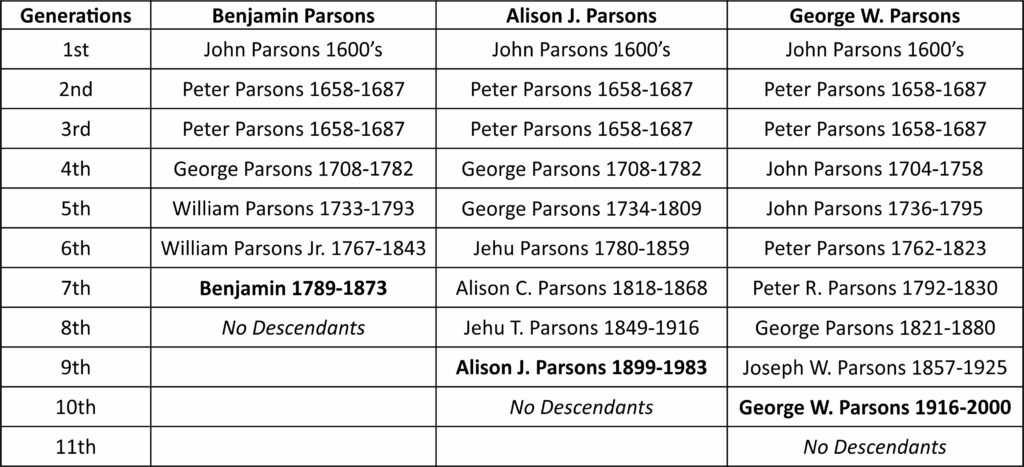
The genealogy of the Parsons family was graciously provided by the Edward H. Nabb Research Center for Delmarva History and Culture. It begins with George Parsons who was born in 1708. He had two sons, William and George. William had a son he named William and it was this latter William’s son, Benjamin, who was the benefactor of the cemetery. George Parsons’ other son, also named George, had a son named Jehu. Jehu had a son named Alison, who named his son Jehu. This Jehu was the mayor of Salisbury from 1898-1900. He named his son Alison after his father and this Alison is the donor of the funds for the design and construction of the brick wall along N. Division St. and the iron gates to the cemetery. A noted Williamsburg architect designed the wall, and the iron gates were hand-fabricated by a noted craftsman in Norfolk. These were added in 1967. In 2000, George W. Parsons of Pittsville, a cousin of Benjamin and Alison, passed away bequeathing a generous amount of his estate for the perpetual care of Parsons Cemetery. Learn more about Parsons Cemetery’s history by taking our two historic walking tours.
The Parsons Cemetery Advisory Committee
INTRODUCTION
The Parsons Cemetery property has been owned by St. Peter’s Church since 1873, when Benjamin Parsons died and bequeathed a 53-acre parcel to the church for use as a cemetery.[1] Burials had already taken place on this property since the early 19th Century. From the start, the business plan for Parsons had been that cemetery operations were funded by the sale of burial plots.
Both Rick Fahey and Bob Taylor had served as senior wardens on the church vestry, and they both were knowledgeable about how the church had administered Parsons Cemetery. By the late 20th century, both men knew that the Parsons business plan would have to change, because the remaining number of salable burial plots was shrinking. Parsons Cemetery was in need of a new business plan.
1986: THE YEAR THE PROBLEM BECAME EXACERBATED
Prior to 1986, it had seemed that Parsons had plenty of unsold burial plots. Years earlier, about 20 acres had been designated for gravesites, and there were still 2 of these acres that had not been sold. In addition, Parsons included another 17 acres, commonly referred to as “the beanfield” which had not been used. However, in 1986 St. Peter’s sold the beanfield lands for a price of $240,000. This land was subsequently transformed into a housing development.
After the beanfield was sold, Parsons Cemetery had only 2 acres left to develop for new gravesites. After burial plots on these on these 2 acres were sold, there would be no more income from gravesite sales. Parsons Cemetery would need another income source. Parsons needed to develop its own substantial income-producing endowment fund.
Historically, portions of the money derived from land sales had been deposited into two small endowment accounts–one for Parsons Cemetery and one for St. Peter’s Church. These accounts were invested with Dean Witter and in Mercantile Bank and Trust. Vestry minutes state that in early 1986, the endowment account amounted to $197,383 for St. Peter’s Church, while Parsons Cemetery’s endowment account held $121, 261. There were discussions about how the “beanfield” sale money should be divided between the church and the cemetery.
1994: THE PARSONS CEMETERY PERPETUAL CARE FUND IS ESTABLISHED AT THE CFES
In 1994, Rick Fahey led Parsons Cemetery to establish a Perpetual Care Endowment Fund at the Community Foundation of the Eastern Shore. St. Peter’s Church began transferring most smaller Parsons endowment accounts to CFES. This fund would eventually contain and replace almost all of the Parsons endowment monies. Then, in the year 2000, George Parsons (a distant cousin of Benjamin Parsons) died and bequeathed $400,000 to Parsons Cemetery. In 2004 this money was deposited into the Perpetual Care Endowment Fund at the CFES. The fund had been designed with an historic portion, which cannot be withdrawn, and an “available” portion. The available portion can be withdrawn, as needed, to cover current expenses.
FOUNDING OF THE PARSONS CEMETERY ADVISORY COMMITTEE (the PCAC):
In 2004, Fahey and Taylor recognized that to better administer Parsons Cemetery and to accumulate an adequate Perpetual Care endowment fund, the cemetery would need to be administered in a more business-like manner. They organized a six-member “Parsons Cemetery Advisory Committee,” or PCAC. Taylor and Fahey functioned as co-chairmen of the PCAC until about 2009, at which time Fahey assumed most of the leadership duties. Mike Wessels, a St. Peter’s parishioner, had been recruited to serve as treasurer of the PCAC. People of all faiths, not just St. Peter’s parishioners, were buried at Parsons, and it made sense to also involve the larger community. Correspondingly, Neill Carey, not a member of St. Peter’s, was asked to join the PCAC, and he became the organization’s secretary. Tom Smith and Anne Shaw were welcomed as the other founding members.
THE PCAC STARTS TO WORK
At its first meeting in 2004, the PCAC supported clearing the cemetery’s last 2 acres, so that this land could be sold as cemetery plots. Clearing of the land was accomplished by 2005. This action provided 2,200 “new” burial plots for potential sale.
The first PCAC meetings were held at 211 West London Avenue, a house (with outbuildings), located near Parsons Cemetery and owned by Parsons. Taylor suggested that “211 West London Ave” should be sold, and the proceeds from the sale used to build a new Parsons Cemetery office building. The new building could be located on the Parsons Cemetery grounds, on Stepney Lane. PCAC members embraced this idea, and the London Avenue property was sold in 2006.
Construction of the new Parsons Office building was completed in 2007. The PCAC members and their spouses contributed mightily to the building project. Margy Taylor contributed drawings for the proposed building. Fahey’s business, Peninsula Roofing, contributed the roof installation for the building. Horticulturist Jan Adams and Holloway Funeral Home personnel contributed landscaping services. Kathy Fahey contributed interior design ideas. Attorney Ann Shaw contributed legal services. An “Open House” and dedication ceremony was held on June 14, 2008.
In 2005 the PCAC entered into an agreement with Holloway Funeral Home. For $55,000 per year, Holloway agreed to provide day-to-day management and care for Parsons Cemetery. An on-site Parsons manager, Rusty Barnes, would be provided by Holloway. A desk and workspace were provided for Rusty in the new Parsons office building, and a long-term business relationship between Parsons and Holloway Funeral Home was begun. Keith Downey represented Holloway’s interests at the PCAC meetings, and Holloway’s Dick Johnson provided financial accounting.
As early as 2005 there was PCAC interest in data processing for handling the cemetery’s business operations and for computer-assisted mapping of the cemetery grounds. The Lewes, Delaware Presbyterian Church was known to be using the Ramaker CIMS Cemetery Software. Bob Taylor paid a visit to that site and was given a demonstration of the system. The Lewes Presbyterians seemed well-pleased with CIMS. Back in Salisbury, the PCAC’s most computer knowledgeable members looked into CIMS and decided that it would be a good fit for Parsons Cemetery. The effort to purchase and install CIMS was led by Neill Carey, Tom Smith, Kathy and Rick Fahey, and Rusty Barnes. In 2006 work began toward installing the CIMS system, which would ultimately include a digitized map of the cemetery.
By the middle of 2006, most Parsons-related endowment monies had been transferred from St. Peters to the Parsons Cemetery Perpetual Care Fund at the Community Foundation. In 2007 the Perpetual Care Fund amounted to $764,000. In the worldwide financial crisis of 2008, the Perpetual Care Fund sank sharply, but soon began a recovery. By 2012, with a better stock market plus a gift of a $50,000 from Shirley Reeves, a St. Peter’s parishioner, the Perpetual Care Fund had risen to nearly $900,000.
Historically, St. Peter’s Church had also held two other, relatively small cemetery-related funds. One was the Jackson-Humphry Fund which provided for their family’s gravesite maintenance. Over time it would be arranged for this fund to be housed in the CFES. Another small fund, the “Easton Episcopal Fund” remained separate from the CFES.
MORE PCAC ACCOMPLISHMENTS
In 2009, Carol Smith, a neighbor of the cemetery property, joined the PCAC. Carol’s wealth of knowledge and her skills in public relations were great assets to the PCAC. She made sure that Parsons Cemetery got the good publicity it deserved. In 2010 Mike Wessels retired from the PCAC, but St. Peter’s parishioner Bob Sousa took his place. Horticulturist Jan Adams also began her service on the PCAC in 2010.
The PCAC recognized a developing trend, with the public seeming to favor cremations rather than more traditional undertaker services. The PCAC responded by providing more columbaria to accept the cremains. The columbaria were placed on a site near the rear of the cemetery, overlooking Johnson’s Pond. Kathy Fahey remained active in entering gravesite data into the CIMS data base. Holloway personnel and the PCAC coordinated efforts to maintain and improve the cemetery grounds.
In 2015, construction of a new “Parsons Memorial Walkway and Cremation Garden” was completed. This construction includes a brick walkway loop which extends from the existing cemetery roadway toward Johnson’s Pond. The walkway includes a round, patio-like seating area with a millstone at its center. The area has a peaceful view of the water and can be used for services or ceremonies. At the 2015 dedication ceremony, a harp concert was presented on the brick patio. Salable inurnment sites are located close alongside the walkway, and conventional gravesites are also located nearby. This area is also referred to as “Water’s Edge.”
Also in 2015, due to the efforts of Carol Smith and Tom Smith, Parsons received a $50,000 grant from the Ella and Alison Parsons Trust, housed in the Hampton Roads Community Foundation. In 1967, Alison Parsons had given the money to construct the cemetery’s brick wall and the iron gates along North Division Street. Exactly fifty years later, the Parsons family’s grant money would be used to repair and enhance the wall and gates. Ella and Alison Parsons had been camelia lovers. To honor this love, a portion of the grant was used to plant a camelia hedge along a portion of the south border of the cemetery near North Division Street.
In 2017, Parsons Cemetery began a tradition of participating in Wreaths Across America. Every year, early in the holiday season, this program aims to place a wreath on the grave of every deceased American military veteran. This extends an earlier Parsons tradition which had honored Parsons Veterans’ gravesites on Decoration Day (now called Memorial Day) and on Armistice Day (now called Veterans Day). In early December, Wreaths Across America places wreaths on the gravesite of almost 1500 American veterans buried at Parsons Cemetery. A respectful public ceremony accompanies the laying of the wreaths.
In late 2018, Jonathan R. Holloway began to regularly attend the PCAC meetings. Jon is the 5th generation owner and President of Holloway Funeral Home. He has contributed technical knowledge along with helpful reports and discussion to the PCAC meetings. For many years, a Holloway-employed accountant has presented financial data at the meetings. The on-site manager, a Holloway employee, also attends the meetings.
In 2020, the PCAC decided that the cemetery might benefit from seeking financial support directly from the public. Neill Carey, secretary and a founding member of the PCAC, volunteered to lead this effort to seek contributions from willing donors. The money obtained from these “Friends of Parsons Cemetery” donations is used as working capital which is available for relatively small but very necessary projects. Neill’s “Friends” efforts have been successful, and as of 2026, almost $49,000 has been donated.
Another 2020 success story occurred when a Parsons neighbor, Brent Zaprowski, agreed to serve as a member of the PCAC. Brent, a Professor of Geography and Geosciences at Salisbury University, worked with some of his students to use drones to obtain aerial photographs of Parsons Cemetery. These photos were used to help the CIMS system produce accurate maps, and for this innovative work, Parsons Cemetery won Preservation Maryland’s Community Choice Award. Also, Brent was able to use ground penetrating radar to resolve questions of exact gravesite locations. Brent has helped Parsons obtain a grant to help with shoreline stabilization along Johnson’s Pond. He is enthusiastic about the cemetery as “green space” and was successful in working to have Parsons designated as an arboretum.
In 2023, the Delmarva Pet Garden at Parsons Cemetery was dedicated and began providing a place to bury and memorialize beloved pets. At the dedication ceremony, A statue of St. Francis of Assisi was unveiled. Father David Michaud, Rector at St. Peter’s Church, blessed all live animals which had accompanied their owners to the event. Since then, a yearly Blessing of the Animals event has been held.
On March 4, 2025, Father David presented Rick Fahey with the prestigious John B. Atkins Sr Award for Exemplary Service. This award honored Rick for his “nearly 25 years of selfless service to the management and growth” at Parsons Cemetery.
PARSONS CEMETERY FINANCES, AS OF 2026
In late summer, 2026, the Parsons Cemetery financial picture seems encouraging, especially as regards its Perpetual Care Endowment Fund, housed at the Community Foundation of the Eastern Shore. On August 31st, this fund had grown to $2,219,893.06. Also housed at the CFES is the cemetery’s Jackson-Humphreys Fund at $429,799.31. The cemetery’s Easton Episcopal Funds, not held at the CFES, were valued at $48,993.22. The grand total of Parsons endowment funds was $2,698,685.59.
It is the goal of the Parsons Cemetery Advisory Committee to grow the Perpetual Care Endowment Funds to at least $3,000,000. At least one PCAC member has expressed the belief that a goal of $4,000,000 may be appropriate.
Written by Robert L. Taylor – October 2, 2026
[1] The history of the land which is used for Parsons Cemetery may be more complex than will be treated here. For instance, recent findings have suggested that the land which Benjamin Parsons bequeathed may have been less than 53 acres. St. Peter’s Church may have acquired some of the land at a later date, by purchasing it.